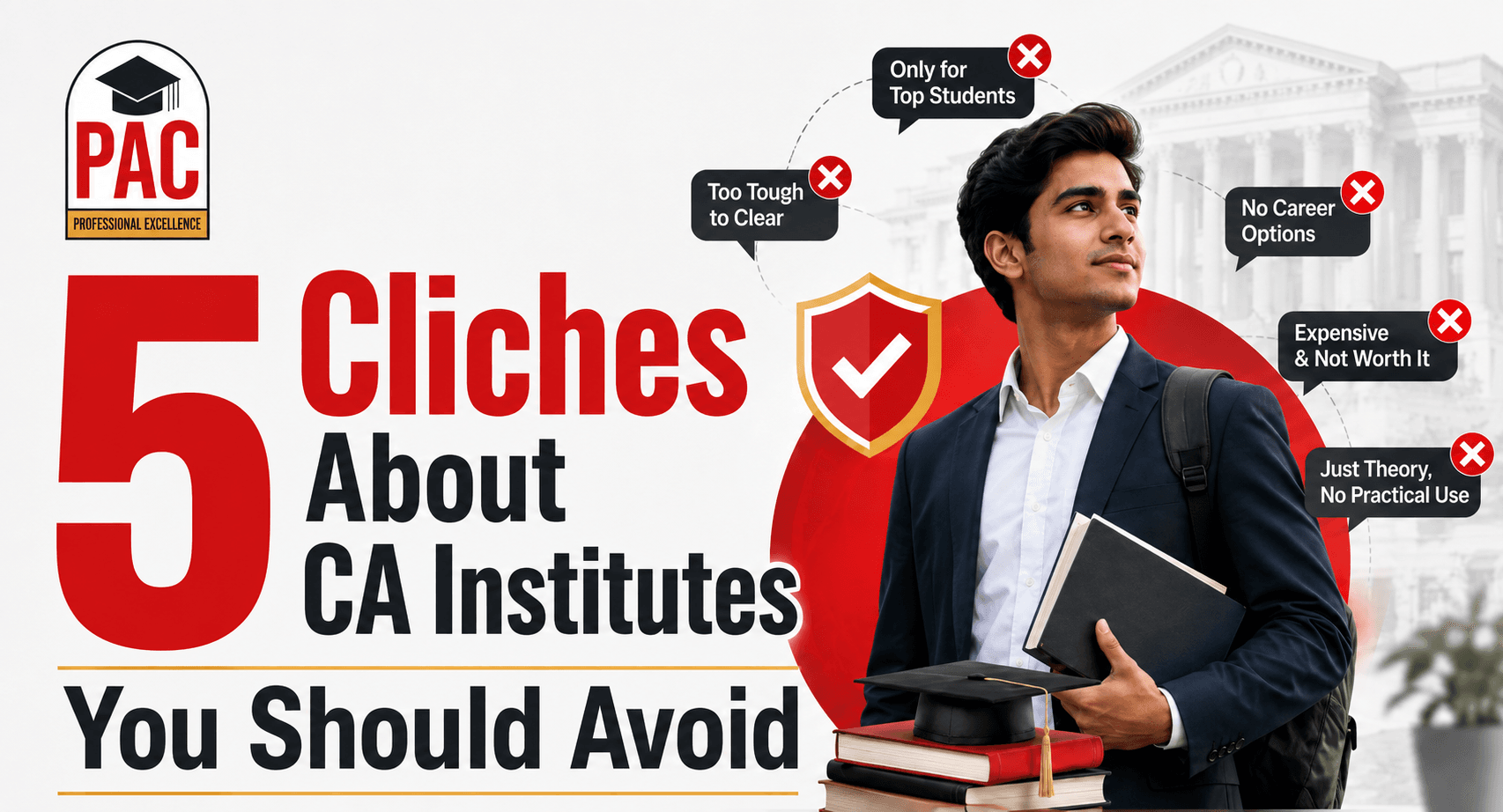
If you’ve asked around about Chartered Accountancy in Pakistan, you’ve probably heard the same recycled advice from seniors and relatives. However people believe that a bigger institute isn’t automatically better, the highest fee doesn’t guarantee quality, self-study rarely beats structured mentorship, not every institute teaches CAF and CFAP the same way, and failing one attempt doesn’t mean you picked the wrong place.
Believing these cliches can quietly waste your time, money, and confidence long before your actual CA journey in Pakistan even properly begins. In this blog, we’re breaking down five of the most repeated myths about CA institutes in Pakistan, why they fall apart under scrutiny, and what actually matters when you’re picking where to study.
Cliche vs Reality: A Quick Comparison
| The Cliche | The Reality |
|---|---|
| A bigger institute always delivers better results | Smaller batches often mean more one-on-one faculty attention |
| The highest fee means the best quality | Fee structure often reflects overhead and marketing, not pass rates |
| Self-study alone is enough to clear CA | Structured guidance usually reduces repeated attempts and wasted time |
| Every CA institute teaches the syllabus the same way | Faculty experience and teaching methodology vary a lot |
| Failing an attempt means you chose the wrong institute | Consistency and a smarter study plan matter more than switching institutes |
Cliche #1: Is a Bigger CA Institute Always the Better Choice?
Walk into any CA-related Facebook group and someone will tell you to join the institute with the most branches or the largest student body. The logic sounds reasonable: more resources, more reputation. But bigger campuses often mean bigger classrooms, and bigger classrooms mean less individual attention.
When one teacher is handling a room full of a hundred students, it becomes hard to notice who’s genuinely struggling with a concept and who’s just nodding along. This is exactly why so many students find CAF and CFAP more difficult than they should be, even at well-known institutes. What actually helps is a manageable batch size, regular testing, and faculty who track individual progress instead of just racing through the syllabus.
Cliche #2: Does the Highest Fee Always Mean the Best Institute?
There’s a common assumption that if an institute charges more, it must be offering something better. In reality, tuition often reflects campus location, marketing budget, and brand recognition rather than actual teaching outcomes. On top of institute fees, CA students already pay separate registration and exam charges to ICAP, so it helps to understand exactly where your money is going.
Before enrolling anywhere, it’s worth comparing the real financial investment of CA against ACCA and checking pass rates, faculty credentials, and mock exam systems rather than assuming a higher price tag automatically means better preparation.
Cliche #3: Can You Really Skip an Institute and Just Self-Study?
Self-study sounds appealing mainly because it feels cheaper and more flexible. Some students do clear early papers this way, especially at the Foundation stage. But CA subjects get progressively technical, and without someone to point out where you’re going wrong, the same mistakes tend to repeat attempt after attempt.
In fact, the honest pros, cons, and reality of self-study for CA in Pakistan show that most students eventually need guidance anyway, just later, and often after losing an attempt or two along the way.
Cliche #4: Do All CA Institutes Really Teach the Syllabus the Same Way?
Since ICAP sets the official syllabus, people assume every institute delivers it identically. That’s not accurate. The syllabus is fixed, but the depth of explanation, the quality of practice material, and how much one-on-one time you get with teachers can vary enormously between institutes, even within the same city.
Some institutes lean on rote learning, while others build conceptual clarity that carries over into articleship. This is one of several essential facts about CA institutes worth checking before you enroll anywhere, rather than assuming all options are interchangeable.
Cliche #5: Does Failing an Attempt Mean You Chose the Wrong Institute?
Failing a CA paper feels devastating, and it’s tempting to blame the institute and switch immediately. Sometimes that’s the right call, but often it isn’t. CA remains genuinely difficult by design: as of 2023, ICAP counted just over 9,106 active members across Pakistan and abroad, a number that shows how selective the qualification stays despite thousands of students registering every year.
Before switching institutes, it’s worth honestly reviewing your study strategy after a failed attempt first. Sometimes what’s needed isn’t a new institute at all, just a more disciplined revision plan for next time.
How Does PAC Help You Avoid These CA Institute Cliches?
The Professionals’ Academy of Commerce, known as PAC, has spent over three decades building its reputation as one of Pakistan’s leading institutes for CA and ACCA, directly countering these cliches instead of leaning on them.
How is PAC Different?
PAC is a Registered Accounting Education Tutor of ICAP and an Approved Learning Partner of ACCA (UK), a body whose global membership has grown past 750,000 members and students across 180 countries, meaning PAC’s affiliations connect students to genuinely international standards, not just local branding.
Why Choose PAC?
Rather than chasing size, PAC keeps faculty accountable through structured testing and mentorship across its Lahore, Islamabad, Peshawar, and Sialkot campuses, plus an online learning option, and its results show it: 71 Gold Medals and 174 Certificates of Merit in ICAP and ACCA exams. If you’re comparing options, explore PAC’s CA program or ACCA program directly instead of relying on cliches to decide for you.
If you are ready to begin your journey as a successful accountant then contact PAC today. Apply for admission to secure your slot at the most prestigious institute of accounting that has countless success stories.
Frequently Asked Questions
Is it true that a CA institute with more branches is automatically better?
Not necessarily. More branches can mean wider access, but they don’t guarantee smaller classrooms or better individual attention. Batch size, faculty consistency, and how closely your progress gets tracked matter more.
Does paying a higher tuition fee guarantee faster CA results?
No. Higher fees often cover overhead like campus location and marketing rather than better teaching outcomes. It’s more useful to compare pass rates, faculty experience, and mock testing systems than the fee alone.
Can I really prepare for CA exams through self-study without joining an institute?
It’s possible for some subjects, especially early on, but CA gets increasingly technical, and unresolved doubts tend to compound over time. Most students find structured guidance ends up saving more time than it costs.
Do all ICAP-recognized CA institutes teach the syllabus the same way?
No. While the syllabus itself is standardized by ICAP, teaching depth, practice material quality, and faculty experience vary widely between institutes, even within the same city.
If I fail a CA paper, does that mean I picked the wrong institute?
Not automatically. CA has a famously tough global pass rate, and one failed attempt is common even among strong students. Review your own study strategy before deciding the institute itself is the real issue.
What should I actually look for when choosing a CA institute in Pakistan?
Check ICAP recognition, realistic batch sizes, faculty credentials, mock exam systems, and past results like gold medals or certificates of merit, rather than judging by campus size or advertising alone.